a cross-border association of Belarus, Poland and Ukraine

Euroregion “Bug”

A shared neighborhood space where the Brest Region is connected with the Lublin Voivodeship and Volyn not only by a common border, but also by logistics, natural areas, cultural exchange, local initiatives, and a long history of cooperation.

1995 — founded 1998 — Brest Region joined ≈ 80 thousand km² more than 5 million residents
  • Euroregion “Bug” is a framework for cross-border cooperation, not a separate administrative unit.
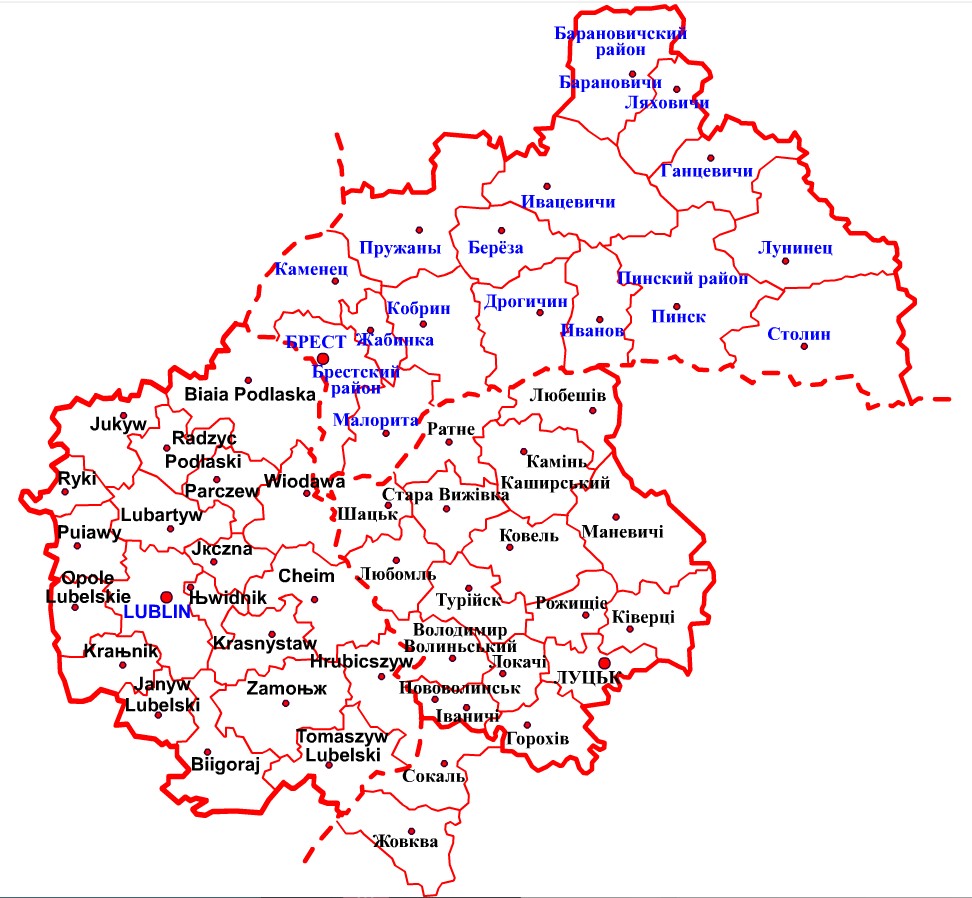
  • Its key cities are Brest, Lublin, and Lutsk.
  • The region’s main focus areas include transport, ecology, tourism, humanitarian exchange, security, and the development of local initiatives.

What is the Euroregion “Bug”

29.09.1995

Launch in Lutsk

It was then that the agreement for the creation of the cross-border union "Euroregion "Bug"" was signed.

05.1998

Joining of the Brest Region

The Brest Region became a full member of the union and took its natural place as the western gateway of Belarus.

AEBR

European Network

Since June 1996, the Euroregion “Bug” has been a member of the Association of European Cross-Border Regions.

Brest · Lublin · Lutsk

Three Key Centers

These cities form a recognizable framework of the cross-border space and define its cultural and transport geography.

Form of Cooperation

The most important form of cooperation between cross-border regions has been the cooperation within the framework of the cross-border union "Euroregion "Bug"".

Work on the idea of creating the Euroregion at the intersection of Belarus, Ukraine and Poland began in 1992. However, the cross-border union "Euroregion "Bug"" was only formed in September 1995. At the initial stage, its composition included: the Volyn Oblast of Ukraine, the Lublin, Chełm, Tarnobrzeg and Zamość Voivodeships of the Republic of Poland.

the cross-border union "Euroregion "Bug"" was only formed in September 1995. At the initial stage, its composition included: the Volyn Oblast of Ukraine, the Lublin, Chełm, Tarnobrzeg and Zamość Voivodeships of the Republic of Poland.

Since the union has been formed from its inception and to this day is an open formation, in May 1998 the Brest Region of the Republic of Belarus and the Białystok Voivodeship of the Republic of Poland joined its ranks.

After the administrative reform in Poland, the members of the cross-border union "Euroregion "Bug"" are the Brest Region of the Republic of Belarus, the Lublin Voivodeship of the Republic of Poland and the Volyn Oblast of Ukraine.

Since June 1996, Euroregion “Bug” has been a member of the Association of European Border Regions. Euroregion “Bug” covers an area of about 80 thousand square kilometers, and its population exceeds 5 million people. The largest cities in the region are: Lublin — 356 thousand people, Brest — about 300 thousand people, Lutsk — 219 thousand people, Baranovichi — 168.9 thousand people, and Pinsk — 131 thousand people.

The territory of Euroregion “Bug” is crossed by major transport routes linking the countries of Western Europe with Russia, Ukraine, and Belarus. Its territory includes passenger and freight border crossings of European significance. The natural value of Euroregion “Bug” is reflected in the establishment of four national parks within its territory.

The governance structure of the cross-border association includes the Council (10 members from each country), the Presidium of the Council (one representative from each country with a rotating chairmanship), the Secretariat, the Audit Commission, and working groups established in selected areas of cooperation. To manage the activities of the Euroregion, national Secretariat Offices were established in Brest, Lutsk, and Chełm. The main areas of activity of Euroregion “Bug” include the further development of mutually beneficial economic relations, cooperation in the social and cultural spheres, as well as work on environmental issues and the prevention of emergency situations. Joint working groups have been created and operate in these areas.

Within the framework of the regional association, the following are considered: environmental projects, projects for the joint use of railway and road border crossings, their reconstruction and expansion, the creation of freight terminals, and much more. Organisational structure of the Cross-Border Association “Euroregion Bug”. Funding for joint projects is planned to come from the contributions of the founding members of the association, as well as from funds provided by the European Commission under the PHARE and TACIS programmes. At present, various cross-border projects are being implemented in the Brest Region under the TACIS Programme.

Under the TACIS Cross-Border Cooperation Action Programme, a decision was made to allocate 7 million euros for financing the construction of the Kozlovichi-2 freight terminal. On February 14, 2002, another meeting of the Council of the Cross-Border Association “Euroregion Bug” was held in Brest.

Timeline

1992–1995

Development of the cross-border association concept

The idea of cooperation at the junction of Belarus, Poland, and Ukraine had been discussed since the early 1990s and gradually evolved from a concept into an institutional framework.

29.09.1995

Establishment of Euroregion “Bug”

At the initial stage, the Euroregion included Volyn Region and the Polish border voivodeships, laying the foundation for the further expansion of the format.

06.1996

Accession to the Association of European Border Regions

This strengthened the international visibility of the association and secured its place within the wider European network of cross-border cooperation.

05.1998

Brest Region becomes a full member

After the Belarusian side joined, the Euroregion finally took shape as a полноценное?

1999–2000

New composition after the administrative reform in Poland

The Polish side came to be represented by the Lublin Voivodeship, while districts of Lviv Region appeared in the format as historical participants.

2000–2020

From projects and forums to a new context

The Euroregion’s agenda covered transport, ecology, cultural and educational exchanges, security, and small-scale local initiatives. Today, this history should be presented honestly: as meaningful accumulated experience in cross-border cooperation, rather than as a mechanically “frozen” structure of the past.

Areas of Cooperation

Transport and Logistics

Major transport routes pass through the territory of Euroregion “Bug”, linking the countries of Western Europe with Belarus, Ukraine, and the broader Eastern European area.

Ecology and the Bug River

The Bug River, the water systems of Polesia, and protected natural areas have long made environmental issues one of the most natural fields for cross-border cooperation.

Tourism and Cultural Routes

Brest, Lublin, Lutsk, Białowieża Forest, Polesia, small historic towns, and cross-border routes together create a clear and attractive narrative for tourism promotion.

Education and Humanitarian Relations

The Euroregion has always placed great importance on exchanges between educational institutions, cultural projects, sports, youth initiatives, and direct contacts between local communities.

Security and Cooperation Between Services

The cross-border agenda included the prevention of emergency situations, environmental monitoring, the work of профильных служб, and discussion of joint solutions.

Information and Shared Databases

Even older materials reflect the idea of joint information platforms, maps, databases, and digital tools for border regions.