What an Old Postcard of Brest Can Tell You
Reading a street view through its details: names, shop signs, paving, passengers and the back of the card. Two examples from the collection of Brest postcards.
An old postcard of Brest first catches the eye with a familiar building or a street that has disappeared. But linger over it a little longer, and your gaze moves to the shop signs, the paving, the passengers on the platform. These details help you ask questions about the life of the city. Let us try to read two genuine postcards from the portal's collection: Policejska Street and the arrival of an express train.
One postcard has several dates
Distinguish between the time the photograph was taken, the time the postcard was issued and the time it was sent. A photograph could be printed later and used in several editions; a card that had been bought could lie with its owner for a long time. If the postmark is known, it dates the mailing, not automatically the scene shown.
First write down the information that is actually available: the printed name of the town and the subject, the publisher, the number in the series, the sender's signature, the postmark. Then note your conclusions and how certain you are. If only the front is visible, the exact date of publication may remain an open question.
The name helps you find the place
Brest postcards carry names of the city and its streets from different eras and in different languages. It is useful to copy them out literally and then match them to a modern address. In the selection of the main streets of the centre, Policejska is matched with today's Sovetskaya Street, and Dvoryanskaya with Mickiewicz Street. This way an old name becomes a key to the search rather than a puzzle in the margin of the picture.
A single caption is sometimes not enough: check the direction of the street, the position of the crossroads, the neighbouring buildings. The angle of view, cropping and changes in the buildings can make a familiar place unrecognisable. A convenient starting point for comparison is an old map and several pictures of the same street.
Example one: Policejska Street
On the postcard showing Policejska Street, a large caption is placed above the picture; on the right, the French name "Rue Policejska" is printed. This alone makes it possible to separate the name of the subject from the names of shops within the frame. At the bottom you can see uneven stone paving, with buildings and passers-by on either side.
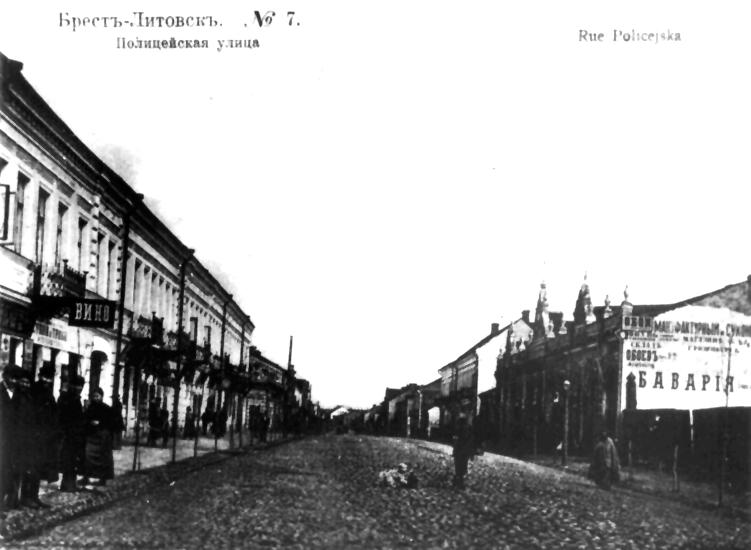
Start with the ground floors of the houses. On the left you can read the sign "ВИНО" (wine), and other shop lettering is visible along the street. They suggest where to look for information about the shops and their owners, but blurred letters must not be filled in by guesswork. Enlarge the original, copy out the fragment you can read with confidence and compare it with another copy or a directory.
Then look at the road and the edges of the street. The paving, pavements, entrances and the position of people show how this particular stretch was laid out at the moment the photograph was taken. From a single view you cannot tell whether the outskirts and neighbouring blocks looked the same. But you can ask a question that can be checked: how did this stretch of street change in later pictures?
Finally, follow the line of the facades. The number of storeys, the shape of the windows, projecting balconies and the gaps between buildings give you reference points for comparison. Once you have recognised one building, you can check its neighbours. This kind of reading is slower than instant recognition, but it helps you avoid confusing similar views.
Example two: the arrival of an express train
The second postcard is easy to read as a railway view: a canopy on the left, a row of carriages on the right, and between them a platform with people. The printed caption calls the scene the arrival of an express train. For a first reading, it helps to set aside the history of the station building for a while and look at how the space of the platform is arranged.
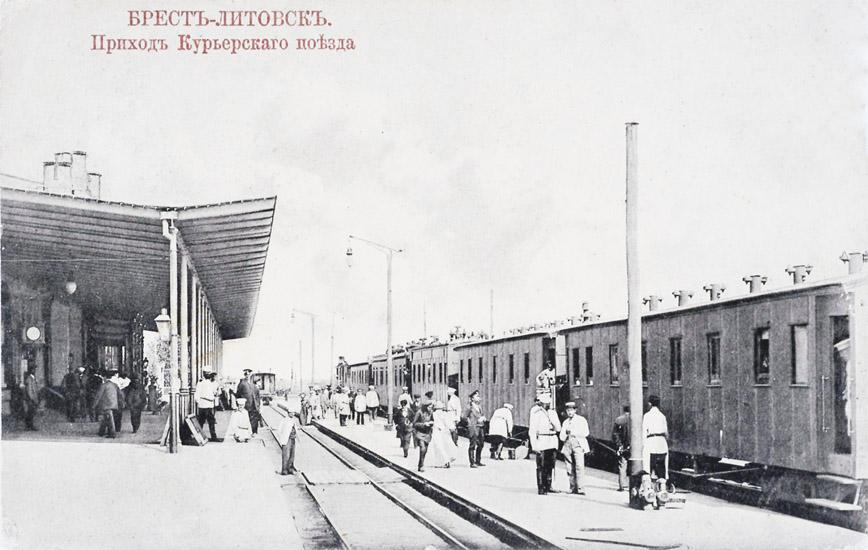
Adults and children, single figures and small groups can be made out in the frame; some people are carrying things. These observations give the station a human scale. But a person's name, occupation, origin and purpose of travel cannot be established from appearance. It is better to describe a visible detail than to invent a passenger's biography.
Compare the edges of the canopy, the tracks and the position of the carriages with other views of the station. It is the recurring elements that help you tell what was photographed from a different point and what was actually rebuilt. More angles are available in the selection "The Station and the Railway".
The back turns a street view into a personal story
If you have a paper postcard or a scan of both sides, turn it over. The address shows the route of the correspondence, and the text explains to whom and why the card was sent. Sometimes the message has almost nothing to do with the place shown: the sender simply chose a pretty view. That is why you should record separately what the photograph tells you and what the sender tells you.
Copy out the addressee's name, the address, the date of the letter and the words you can read with confidence. Mark an unclear passage as not deciphered and keep a picture of it. Even a short greeting can give a direction for family research, especially if other letters have survived alongside it. We explain how to continue such work in the article on researching ancestors from the Brest Region.
Why a postcard shows a selected city
A frame has edges, and a series of postcards involves a choice of subjects. The photographer chose the point from which to shoot, and the publisher chose the images to print. A view of the station tells you a lot about the station, but it does not describe the living conditions of all townspeople. An empty street in one picture does not prove it was always quiet; a crowded platform does not allow you to count the usual number of passengers.
Look for neighbouring evidence: a map, another angle, an address directory, a document about the building. Each source answers its own question. A postcard shows the visible appearance of a place, a map clarifies its position, and a document may establish the owner or the date of reconstruction. Together they give a more reliable explanation.
Enlargement and restoration: how to keep the link with the original
To read details you need the best possible scan. Enlargement helps you examine the elements that are there, but it does not add information that is missing from the source. If an inscription cannot be made out, a sharper version of the image does not make it legible.
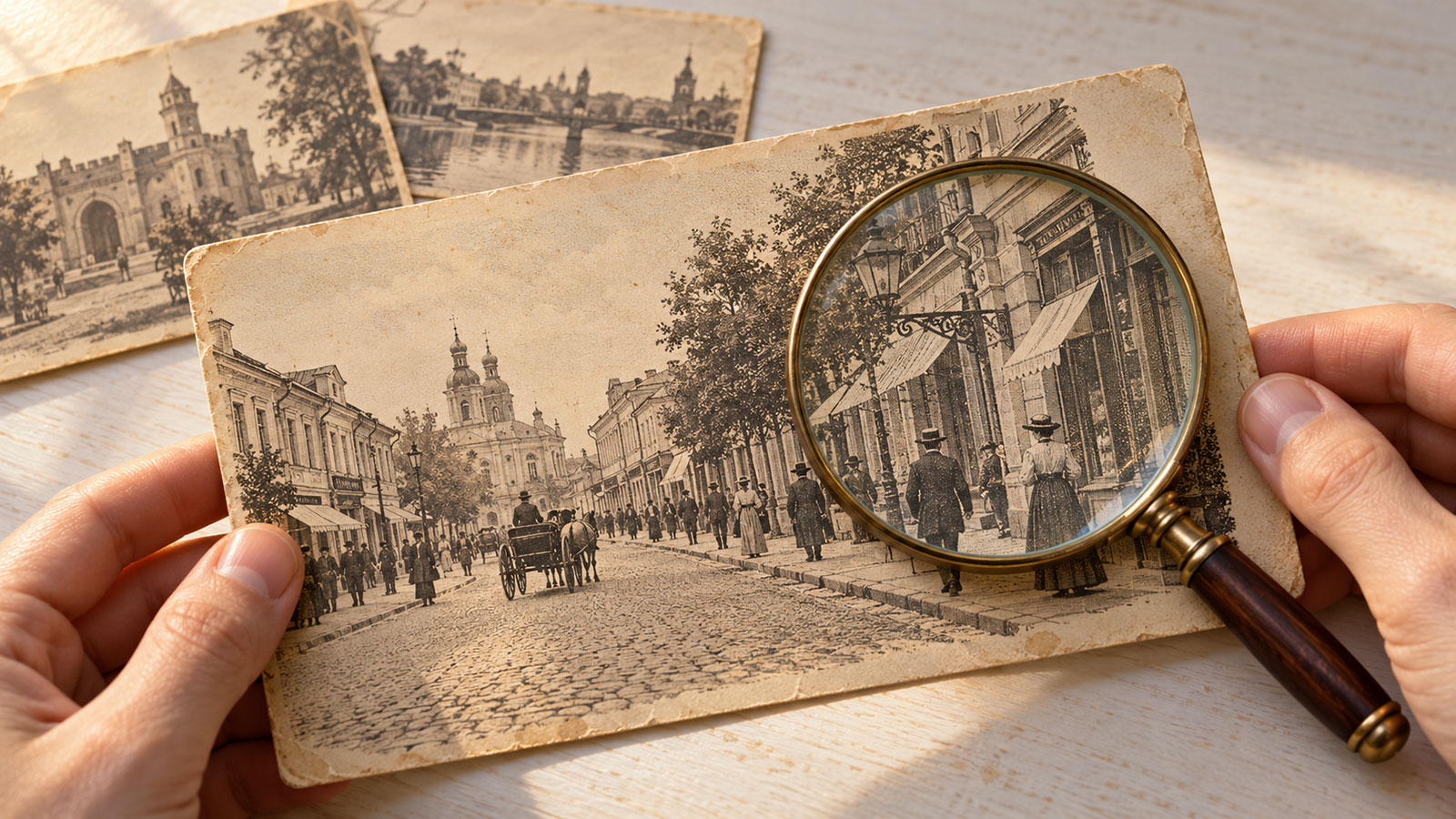
When working with digital restorations, keep the original next to the processed version. Restored colour or a redrawn detail needs to be checked separately against sources. For historical conclusions, rely on the original image and documented information. The modern illustration at the beginning of this article conveys the theme of examining postcards; the real evidence about the city is the two images discussed above.
Try reading a postcard yourself
- Write down the caption, the publisher and the series number, if they are visible. Record the information from the back separately.
- Identify the place by its name and two or three stable landmarks.
- Pick five details: a sign, a window, the road surface, a vehicle, a human figure.
- For each one, separate observation from assumption. For example: a balcony is visible; its owner is not yet known.
- Check at least one detail against another view, a map or a document.
- Save the link to the postcard and frame your next question.
After such a reading, even a familiar view becomes richer. You know which details the image has really preserved, where further checking is needed and what to compare your find with. It is these small, verifiable observations that gradually give an old street view its history back.
Sources and materials
- Brest on old postcards: a collection of city views.
- Main streets of the centre: names and the postcard of Policejska Street.
- The station and the railway: the postcard of the arrival of an express train and other views of the station.
- Digital restoration: comparing originals with restored versions.
- Maps of the Brest Region: matching city views with cartographic material.