How to Start Researching Ancestors from the Brest Region
Family papers, old village names, parish registers and archival finding aids: first steps towards a family history you can verify.
Family history often comes down to one short clue: a grandmother was born near Kobryn, a great-grandfather worked on the railway, relatives lived in a village whose name now sounds different. To turn such a story into a family tree, you first need to pin down a specific person, place and time. Even a small set of family papers makes the first archival search far more precise.
Check whether requests are accepted before you apply
As of October 11, 2026, the historical archive in Grodno reports that it suspended the registration of genealogical requests from private individuals on February 1, 2025, and recommends independent work in the reading room by appointment. At the historical archive in Minsk, genealogical and thematic requests have been suspended since April 2, 2026, and biographical requests from private individuals since September 17, 2026. Check the current conditions before you travel or submit an application; these restrictions do not mean that all documents are closed to independent research.
Start with one person and one event
Choose the closest ancestor about whom enough information has survived: a grandmother or a great-grandfather, for example. Set a narrow goal: find a birth record, establish a maiden name, learn the parents' names. A question like that leads to a clear next step. Once one link is confirmed, you can move on to the previous generation.
Keep a separate card for each person. It is a convenient place for the full name, spelling variants of the surname, the maiden name, dates and places of birth, marriage and death, and the names of close relatives. Next to each fact, note where it comes from: a certificate, a caption on a photograph, a relative's account. Mark assumptions as such right away, before they turn into accepted family truth.
What to ask your relatives
A conversation about the family works better with a photograph or a letter in hand. Instead of a general question about ancestors, ask people to name those in the picture, explain who wrote from another town, recall neighbouring villages, a school, a workplace. Do not rush the person you are talking to: a single everyday episode sometimes brings back a forgotten name.
- What was the person called at home, and how was the name written in documents?
- What was the maiden name? Were there any second marriages?
- Where did the family live before moving? What was the nearest Orthodox church, Catholic church or other religious community called?
- Who were the brothers and sisters, where did they move, and has any correspondence survived?
- Where are the documents, old albums, employment record books and letters kept? Who wrote the captions on the photographs?
With the person's consent, record the conversation. Separately note the date and the name of the storyteller. If two people remember different years, keep both versions: a document will later settle the question, while choosing too early may lead the search astray.
Gather a home archive
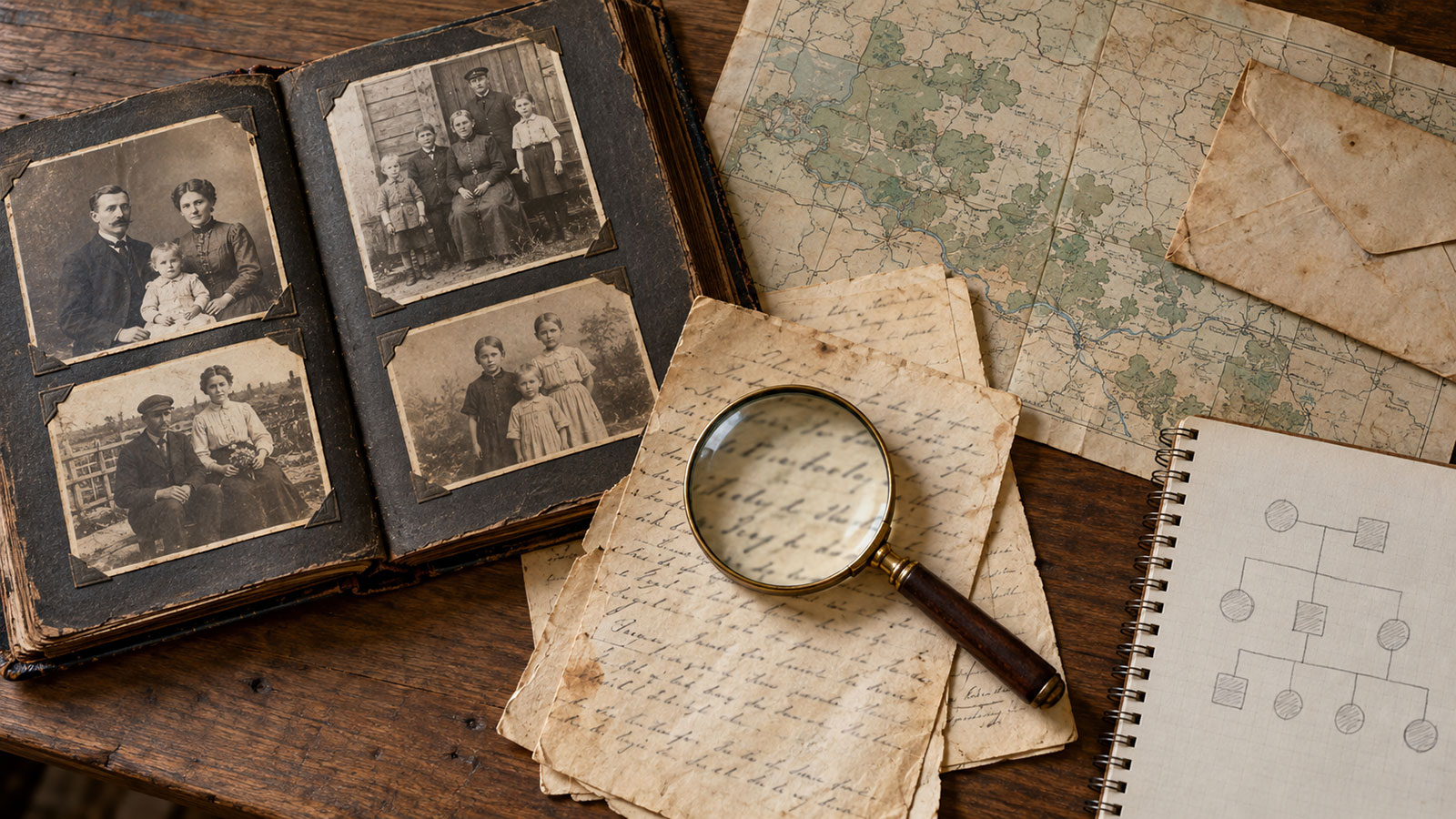
Photograph each document in full, including the back and any enclosures. In a family photograph the faces are not the only thing that matters: a caption, the photographer's stamp and the studio address can tie it to a place and a time. Keep the envelope together with the pages of a letter. Write down who owned the original and who helped identify the people.
Give the copies clear names: surname, type of document, year. For an unknown date, use the note "date not established". Keep the original scan separate from any version in which you increased the contrast or cropped the edges. Make a second copy of the whole collection on another storage device. Publish information about living relatives only with their consent.
Why the modern district is not enough
When searching in the Brest Region, it is important to find out which administrative unit the settlement belonged to in the year you need. The present-day region brings together lands with different administrative histories; today's district boundary does not automatically tell you where to look for a pre-revolutionary register. Start with the current name, then find earlier spellings, neighbouring settlements, the uyezd or powiat, and the parish.
Names could be written in Russian, Belarusian, Polish and other forms. Compare places by several features: neighbours, a river, a road, the distance to a town. An identical name alone does not yet identify a village. A useful aid for this work is the historical maps of the Brest Region.
The "Genealogy" section of the "Archives of Belarus" portal explains how the main records are distributed: documents of the former Grodno Governorate are concentrated mainly in the historical archive in Grodno, and those of the former Minsk Governorate in the historical archive in Minsk. This gives a direction for the search, which then has to be narrowed down to a specific place and document.
Which records to look for
Parish registers (metrical books). They recorded births, marriages and deaths and were kept separately by each religious community. That is why you need to establish not only the village but also the parish or community. In the finding aids for metrical books, check which years have survived. A register appearing in the list does not yet guarantee that the section you need, or a particular person, is there.
Revision lists (revizskie skazki). These are records of the tax-paying population of the Russian Empire. They can help link family members and generations, but they cover specific social estates and years. The official finding aid lets you search files by governorate, uyezd and category of population. For peasant families, the owner of the estate is sometimes important, since documents could be grouped by owner.
Twentieth-century records. Additional information may be found in household registers, lists of voters and taxpayers, and documents on education, employment, land and home ownership. The archival service portal publishes a finding aid to genealogical records of the regional archives, including the Brest archive. Check what survives of the specific set of records and which territory it covers.
A summary table of population figures tells you about a settlement but usually does not list its residents by name. Before pinning your hopes on a census or a directory, find out whether you are looking at a statistical publication, a list of households or personal records. These are different sources for different tasks.
What you can do online
First study the descriptions of fonds and the finding aids, then the file inventories. A fond brings together the documents of a particular institution or another creator of records; an inventory helps you find the files within it. The reference system of the Grodno archive includes electronic inventories and alphabetical indexes of the metrical books of Orthodox and Catholic churches and other communities.
Save the name of the fond, the inventory and file numbers, the date range and the relevant folios, if known. Note the link to the finding aid and the date you viewed it. This way you can return to the find and phrase an order. An electronic inventory describes a file; on its own it does not mean that all of the file's pages are available online.
How to prepare a request or a visit to the reading room
Before contacting an archive, check the current conditions on its website: whether the type of request you need is accepted, how to book a place in the reading room, which documents are available. Establishing a single fact and researching a whole family may be handled as different tasks. For later civil registration records, ask the relevant registry office (ZAGS) where they are kept and how to access them; a single universal date when all registers were transferred to the archive will not help here.
In your working description of the search, collect the person's name, the place of the event, an approximate year with the reasoning behind it, the names of the parents or spouse, the known religion and the sources already checked. If you know the archival reference, add it. Be clear about whether you need a search for a record, advice on whether it has survived, or a copy of a specific document.
A handy template for yourself: "I am looking for the birth record of [first name and surname] in [settlement and its former administrative unit] in approximately [range of years]. Parents: [known information]. Basis for the date and place: [document or family account]. Already checked: [list]. To be clarified: [one specific question]." Before sending, draw up the application according to the archive's rules.
How to check that you have found your ancestor
Compare the record with independent features: the names of the parents and spouse, age, place of residence, occupation, other family events. A namesake in the next village deserves checking but does not yet become a relative. If the surname is spelled differently, keep the original spelling and explain why you link the records.
Copy out not only the convenient line but also its context: the section heading, the date of the event, the date of registration, the witnesses and any notes. If the dates disagree, check whether you are comparing different events or different calendar styles. For each result, record the full source reference: archive, fond, inventory, file, folio, or an exact link to the digital copy.
A plan for your first weekend
- Choose one ancestor and frame one question about him or her.
- Talk to a relative, caption the photographs you can identify and copy the documents.
- Locate the settlement on a map and list the variants of its name.
- Check the relevant archive, parish or community and which years have survived.
- Write down the references you have found and the next step: reading a file, a consultation or ordering a copy.
The result of the first stage may be a very short but verifiable chain: a person, his or her parents, a place and a document that links them. With such a foundation, the search gradually goes deeper, and family stories gain dates, names and sources of their own.
Sources and materials
- Archives of Belarus: the main sources for genealogical research and how documents are distributed between archives.
- Archives of Belarus: metrical books and finding aids showing what has survived.
- Archives of Belarus: revision lists and how they are grouped.
- Archives of Belarus: genealogical records of the regional archives.
- National Historical Archives of Belarus in Grodno: electronic inventories and indexes of metrical books.
- National Historical Archives of Belarus in Grodno: requests, services and the notice on the temporary restriction of requests.
- National Historical Archives of Belarus in Minsk: requests, services and current restrictions.
- Maps of the Brest Region: modern and historical maps for locating places.