Buying a Used Car: What to Check Before You Pay
Documents and VIN, body and mileage, a cold start and a test drive, a workshop inspection and paperwork: a checking routine that protects you from expensive surprises.
Buying a used car always means buying someone else's history. The seller may genuinely not know about an old repair, or may know very well. The decision is made after an hour or two of inspection, so it helps to follow an order: first the documents and VIN checks, then the body and mechanics, then a workshop inspection, and only at the very end the money.
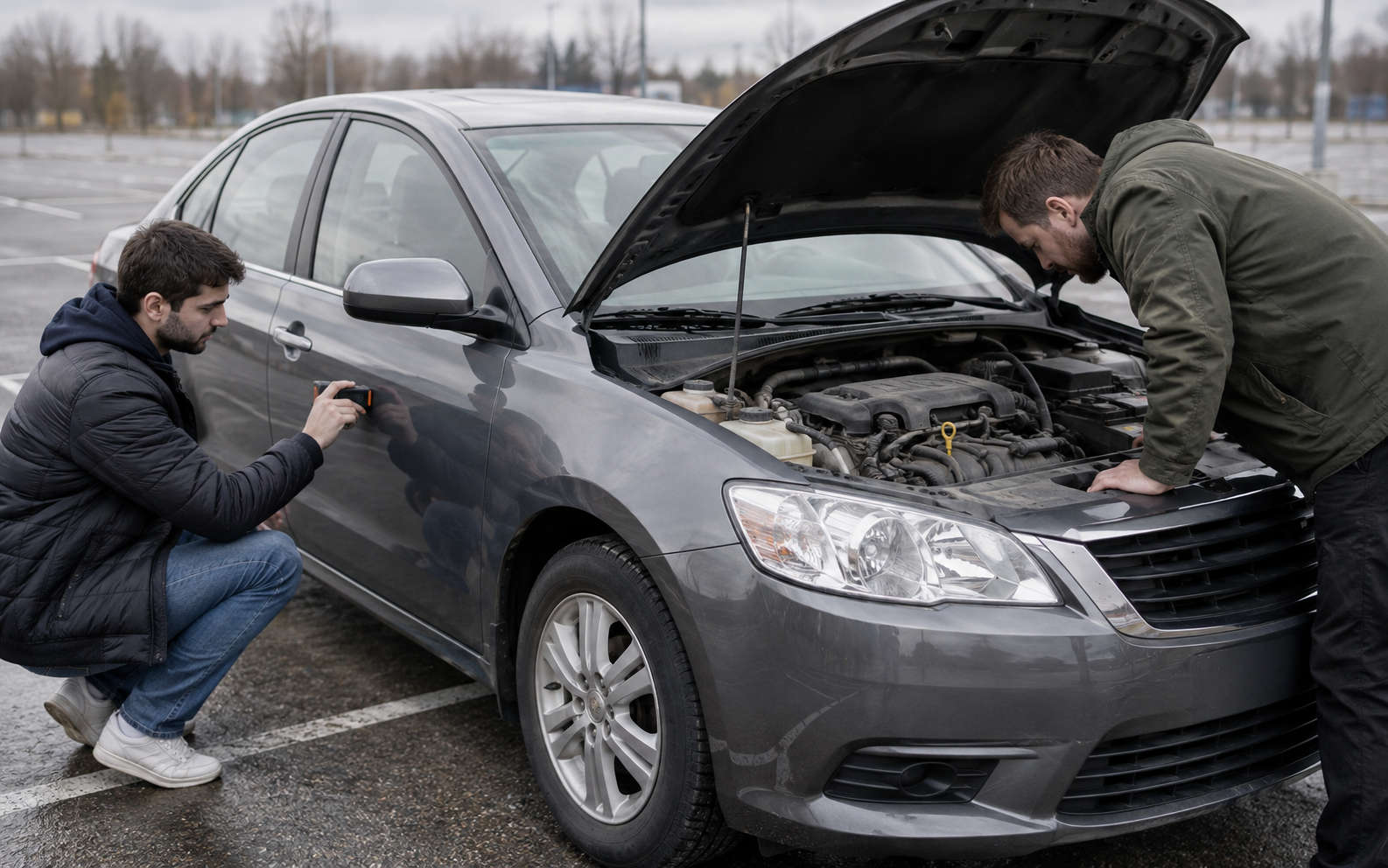
The main rule
Do not hand over any money, not even a deposit, until you are sure that the seller is the owner according to the registration certificate or acts under a notarised power of attorney, and that the VIN on the car matches the documents. Anything that can be checked before the meeting should be checked before the meeting.
Before the meeting: the ad and the VIN
Ask the seller for the VIN and a photo of the registration certificate. An honest seller rarely refuses: the VIN is visible through the windscreen anyway. Compare the year of manufacture, engine and colour in the document with the ad. If the car has been sold before, look for old ads by VIN or plate number: sometimes they show a different mileage. Offers from across the region are also collected on our classifieds board, in the "Cars and motorcycles" section.
The unified portal of electronic services has a Ministry of Internal Affairs service that checks whether a vehicle is on the wanted list. You can search by VIN or body number, and the last six characters are enough; you need an electronic digital signature to log in. Since May 2023 the same portal has also offered a paid VIN check in the register of movable property pledged as collateral: it shows whether the car is pledged, for example under a loan. As a rule, the pledge remains in force when the owner changes, so it is better not to buy a pledged car without the consent of the pledgee.
Documents and the seller
- Check the seller's passport against the owner's details in the registration certificate. If the car is being sold by someone other than the owner, a notarised power of attorney is required; without it, registration will be difficult.
- Find the VIN on the body and on the manufacturer's plate and compare them with the registration certificate. Signs of welding, or altered or painted-over characters near the number, are a reason to stop.
- Ask for the service book, work orders and receipts. Entries with dates and mileage help you understand how far the car has really travelled.
- Ask why the car is being sold and how long the current owner has had it. The answer proves nothing on its own, but it helps you check the story against the documents.
Inspecting the body
Look at the car in daylight, in dry weather and when it is clean. A wet or dirty body hides differences in shade, scratches and blistered paint, and in the evening under a street lamp a repainted panel is almost invisible.
- The gaps between the doors, bonnet, wings and boot lid should be even and the same on both sides. Uneven gaps are often left after a repair.
- Look at neighbouring panels at an angle: does the shade differ? Traces of paint on rubber seals, plastic parts and mounting bolts also give away a respray.
- A paint thickness gauge will reveal repainting and body filler. With factory paint, readings on neighbouring panels are close; if they are several times higher on one panel, it has been repainted and possibly straightened.
- Look under the sills, into the arches and into the spare wheel well: rust and traces of water in the boot tell you more than a shiny bonnet.
- The windows are marked with their year of manufacture: if one of them is noticeably newer than the car, ask why.
Mileage and interior
The odometer reading is the easiest part of a car to change, so compare it with the wear. A worn steering wheel and gear lever, a sagging driver's seat and polished pedals do not fit well with low mileage. Check the mileage against the service records. During diagnostics, a scanner may show the mileage stored in other electronic units.
Check that all the equipment works: power windows, heater and air conditioning, heated seats and windows, headlights, the instrument panel. After the engine starts, the warning lights on the panel should go out. A damp carpet and a smell of mould are a sign of a leak or that the car has been flooded.
Cold start and test drive
Agree that the seller will not start the car before you arrive, and put your hand on the bonnet: it should be cold. A cold start reveals a lot: how the engine starts, whether there is knocking or thick smoke from the exhaust, whether the engine runs smoothly in the first minutes.
- On a straight, level road the car does not pull to one side, and the steering wheel is straight.
- The brakes work without vibration in the pedal or shaking in the steering wheel, and the car brakes in a straight line.
- The gearbox shifts without jerks or delays, and the clutch does not slip.
- Knocking over bumps and a hum that grows with speed are a reason to check the suspension and bearings on a lift.
- After the drive, look under the car for fresh oil or coolant leaks.
A workshop inspection before the deal
Even if you like the car, show it to a mechanic before you pay. An inspection on a lift and computer diagnostics take an hour or two and cost incomparably less than repairing a gearbox or rotten sills. Choose the workshop yourself rather than the one the seller suggests. If the seller refuses to go for diagnostics, that is already an answer.
Service stations and workshops in the region are listed in the company directory, in the vehicle maintenance and repair section.
The result of diagnostics is not just "yes" or "no". A list of what will need replacing soon is a fair argument for bargaining: the cost of this work can be discussed with the seller.
Money and paperwork
The deal is formalised with a written contract of sale. To register the car with the traffic police (GAI), the document of purchase is submitted in three copies together with the new owner's passport, the registration certificate and receipts for the state fees. Cars are registered by the GAI registration units; district departments do not do this. If the seller and the buyer come together and are registered in the same administrative unit, transit plates will not be needed.
The deadlines are set by the Regulation on the procedure for state registration of vehicles (Council of Ministers resolution No. 1849). For a car bought in another EAEU country, 30 days are allowed for this since June 17, 2024. If the car has no valid roadworthiness inspection, it must pass one within 10 days after registration.
Hand over the money after signing the contract, together with the car, the registration certificate and all sets of keys. If you pay in cash, ask the seller to write a receipt for the amount; a bank transfer leaves a record by itself. Before the first drive, check that the car has a valid compulsory third-party liability insurance policy, and take out your own if necessary.
A short checklist for the day of purchase
- The VIN has been checked for wanted status and pledges, and it matches on the body and in the registration certificate.
- The seller is the owner or has a notarised power of attorney.
- The body has been inspected in daylight and with a thickness gauge; the sills and arches have no through-rust.
- The mileage matches the wear and the service records.
- The cold start and test drive went without knocking, pulling or jerking.
- The car has been inspected at a workshop of your choice.
- The contract is signed, and the money has been handed over against a receipt or by bank transfer.
Flawless used cars hardly exist, and the purpose of the check is not to find a perfect example but to know in advance exactly what you are buying. Then the price reflects the car's real condition, and the problems that would surface a month later are discussed with the seller before the deal.
Sources and materials
- Unified portal of electronic services: Ministry of Internal Affairs service "Checking if the vehicle is on the wanted list according to a VIN fragment".
- Myfin: a service for checking whether a car is pledged has been launched in Belarus (May 17, 2023).
- Myfin: registering a car in Belarus - the procedure, documents and details (January 28, 2026).
- Neg.by: the rules for registering and deregistering cars have changed - Council of Ministers resolution No. 294 of 19.04.2024 (June 18, 2024).