Reflectors on jackets and backpacks: how to be more visible in winter
Where to attach a reflector, why a backpack alone is not enough and what to check before walking to school, work or the bus. Belarusian traffic rules and everyday mistakes explained.
A child walks to school in the morning and an adult returns from the bus in the evening, while a dark jacket almost blends into the street. In Brest, Pinsk and Baranavichy this concerns familiar urban routes; for village residents it can also mean walking along a road shoulder. Buying a reflector is only the beginning: check where it sits when you put on a backpack, pick up a bag and turn sideways towards the road.
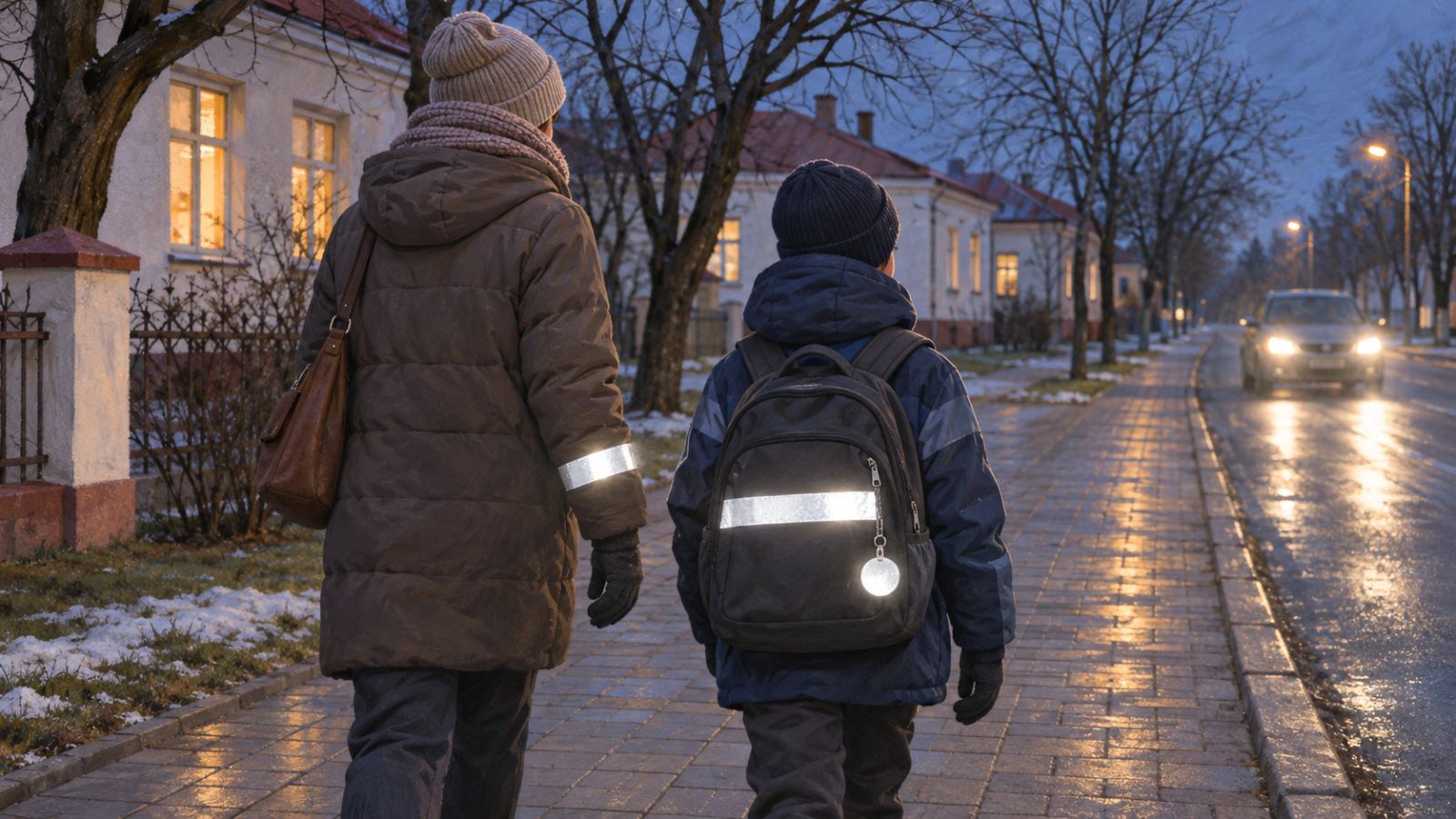
Keep the reflector on the outside
A reflector in your pocket or underneath a bag does not make you visible to a driver. Position the elements where clothing and belongings cannot cover them, and combine their use with a safe route and care when crossing the road.
What Belarusian traffic rules require
Paragraph 17.1 of the traffic rules requires pedestrians walking along a road shoulder or the edge of the carriageway in darkness to wear a reflector. The rule also applies within built-up areas: street lighting does not remove this obligation. Paragraph 2.63 defines darkness as the period between sunset and sunrise.
Use a pavement or pedestrian path for walking. Where neither exists, the rules provide for using a cycle path without obstructing its users, or a road shoulder; walking along the edge of the carriageway is permitted when these facilities are absent or unusable, facing traffic. Having a reflector does not in itself permit you to walk on the carriageway where a usable pavement is available.
Separately, paragraph 17.3 recommends a reflector when crossing a road in darkness away from crossings and intersections. Such a crossing is permitted only under the conditions and restrictions set out in the traffic rules. For an everyday family route, choose a permitted crossing point in advance and keep reflectors on your clothing even on pavements as an additional precaution.
Choose a reflector for your everyday clothing
The Interior Ministry guidance on reflector placement recommends bands on sleeves or trousers and pendants attached to clothing, a schoolbag or a bag. The ministry advises using several elements and highlights white, lemon-coloured and yellow products. Choose an attachment that suits your usual jacket: the item needs to stay on the outside rather than disappear into folds.
Before buying, read the stated purpose, manufacturer details and instructions for attachment and care. Do not assume that every shiny key ring is a reflector simply because it looks similar. If its purpose is unclear, ask the seller for product information; for everyday use, a practical attachment matters more than a decorative shape.
Position elements on different sides
Put on your jacket, fasten it and pick up the belongings you actually take out. Ask someone close to you to look from the front, back and side: does a bag hide the armband, or does the pendant disappear behind your arm? Then turn and take a few normal steps, because belongings change position as you move.
- Attach a band or armband over your sleeve as instructed for the product; do not conceal it under a cuff or glove.
- Add an element visible from the front if the reflective inserts are only on your back.
- Position elements on different sides: a pendant behind you does not provide visibility from the front and side.
- Check the attachment: a pendant should not slip into a pocket, turn its non-reflective side outwards or repeatedly end up beneath a bag.
A backpack helps while it is on your back
A strip on the rear of a backpack helps identify its wearer from behind, but a child may carry the backpack in one hand or take it off at a bus stop. Keep reflectors on the jacket itself as well. Also check that a rain cover, shoe bag or attached toy does not obscure the strip.
Walk together to school, an activity or the bus and discuss where the child comes close to vehicles. Plan the journey home after activities: daytime and evening routes both require care in choosing where to cross. When changing a winter jacket or backpack, check the positioning again rather than relying on the set left on the previous item.
Inspect the surface and attachments
Before going out, check for dirt on the reflective surface, peeling strips and broken fasteners. Clean and wash the product according to the manufacturer's instructions; a sewn-on patch and a separate pendant may need different care. If an element is damaged or no longer stays on the outside, replace it or restore the attachment as instructed.
Do not assign every reflector the same service life or promise a child that a driver will certainly see it from a particular distance. Product condition, headlights, weather and the person's position vary. A reflective strip in a photograph of a backpack is also no substitute for inspecting the actual item the child is taking out today.
Choose your position at stops and crossings carefully
Traffic police guidance published by the Interior Ministry Academy highlights care on slippery roads, permitted crossing points and an unobstructed view. Do not let a hood restrict your view or become distracted by a phone near the carriageway. Before stepping onto the road, assess approaching vehicles and make sure it is safe to cross.
Near a bus or parked car, do not step out from behind an obstruction without checking the road. A reflector cannot let a driver see through vehicles and does not replace compliance with traffic rules. If your route involves a bus, find operators' contacts in our Brest Region transport directory and inspect the waiting area and permitted crossing point in advance.
A quick check before leaving
- The reflectors are on the jacket and bag you are using today.
- Surfaces are clean, fasteners are intact and elements remain on the outside.
- You are visible from different sides, rather than only from behind.
- Your backpack, bag and hood do not cover the elements or restrict your view.
- You have chosen a safe route to school, work or the bus stop with permitted crossing points.
- Even with a reflector, you check the traffic situation before stepping onto the carriageway.
Sources and further reading
- ETALON-ONLINE: Belarusian traffic rules, paragraphs 2.63, 17.1-17.3 and 18.1, 18.4; current edition (checked November 20, 2026).
- Interior Ministry of Belarus: Make yourself more visible in darkness, guidance on positioning and choosing reflectors (checked November 20, 2026).
- Interior Ministry Academy, traffic police guidance: First frosts mean danger on the road, visibility and safe crossing (checked November 20, 2026).